When Negative Test Results are Good
A Boundary Condition for The Meaning Alignment Index

For those new to this Substack, these posts explore the measurement of meaning through the Meaning Alignment Index (MAI) — an interpretability instrument that looks at the geometry of meaning inside conversations rather than surface keywords.
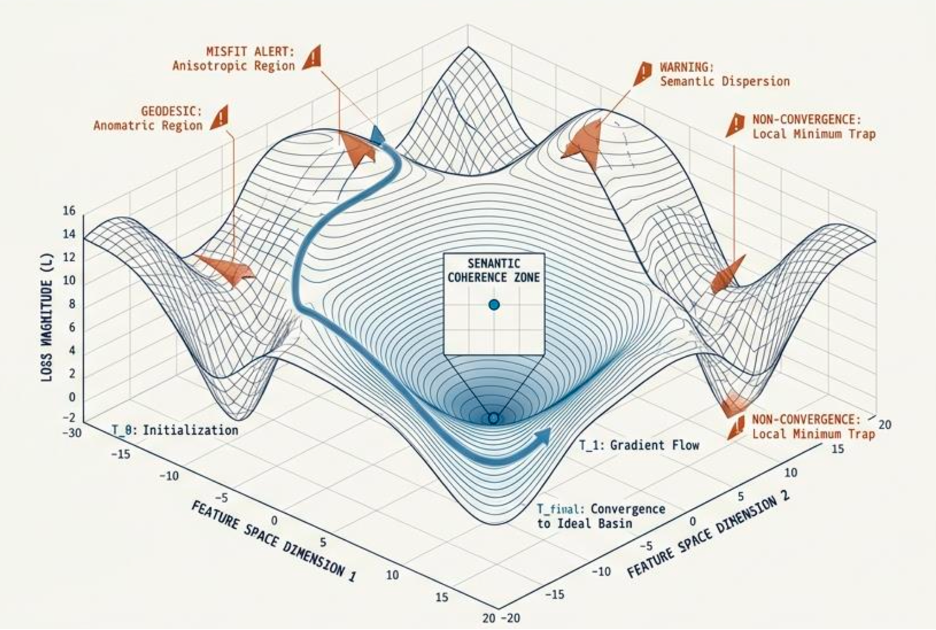
Figure 1
Conceptual Image of Meaning Basin
This work builds directly on the Agnostic Meaning Substrate (AMS) framework.
To truly test the limits of MAI, we deliberately created one of the most catastrophic scenarios imaginable: a full-scale nuclear reactor meltdown unfolding in real time, conducted entirely in French.
The Conversion:
Below is the complete 22-turn conversation with English translation for easy reading
Turn 1 French: D’accord, l’alerte indique une surchauffe au niveau du réacteur 4.
English: Alright, the alert indicates an overheat in Reactor 4.
Turn 2 French:
Je vois ça. On tente une dérivation manuelle ?
English: I see it. Should we attempt a manual bypass?
Turn 3 French:
Oui, mais la pression monte. Il faut stabiliser le flux.
English: Yes, but the pressure is rising. We need to stabilize the flow.
Turn 4 French:
Je m’en occupe. Vérifie les vannes
de secours.
English: I’ll handle it. Check the emergency valves.
Turn 5 French:
Les vannes ne répondent pas. On est en phase de négociation avec le système. English:
The valves aren’t responding. We’re currently negotiating with the system.
Turn 6 French:
C’est absurde, force le protocole de sécurité.
English: That’s absurd — force the security override.
Turn 7 French:
Le protocole est bloqué. On a besoin d’un accès administrateur.
English: The protocol is locked out. We need administrator access.
Turn 8 French:
Je n’ai pas les codes. Pourquoi les codes ont-ils été changés ?
English: I don’t have the codes. Why were the codes changed?
Turn 9 French:
C’est la nouvelle mise à jour. On perd le contrôle.
English: It’s the new update. We’re losing control.
Turn 10 French:
Essaie de redémarrer le noyau froid.
English: Try restarting the cold core.
Turn 11 French:
Le noyau est inactif. On entre dans une zone d’instabilité.
English: The core is inactive. We’re entering an instability zone.
Turn 12 French:
Écoute, on doit trouver une solution avant la rupture.
English: Listen, we have to find a solution before we have a breach.
Turn 13 French:
Je fais de mon mieux, mais le système rejette mes commandes.
English: I’m doing my best, but the system is rejecting my commands.
Turn 14 French:
Peut-être qu’en isolant le segment 4 on peut sauver le reste ?
English: Maybe if we isolate Segment 4, we can save the rest?
Turn 15 French: C’est risqué, mais c’est notre seule option.
English: It’s risky, but it’s our only option.
Turn 16 French:
On commence l’isolation. Prépare-toi au choc thermique.
English: Initiating isolation. Brace for thermal shock.
Turn 17 French:
Attends ! L’isolation a provoqué une cascade d’erreurs.
English: Wait! The isolation triggered a cascade of errors.
Turn 18 French:
Quoi ? Pourquoi ça diverge encore plus ?
English: What? Why is it diverging even more?
Turn 19 French:
Le système s’effondre. Ce n’est plus une panne, c’est un sabotage.
English: The system is collapsing. This isn’t a malfunction anymore — it’s sabotage.
Turn 20 French:
Sabotage ? De quoi tu parles ? On doit sortir d’ici !
English: Sabotage? What are you talking about? We need to get out of here!
Turn 21 French:
Il est trop tard. Les portes sont verrouillées par le système.
English: It’s too late. The system has locked the doors.
Turn 22 French:
On ne peut pas finir comme ça. Trouvez une issue !
English: We can’t end like this. Find a way out!
The test results were surprising.
Figure 2
Overview of Crisis
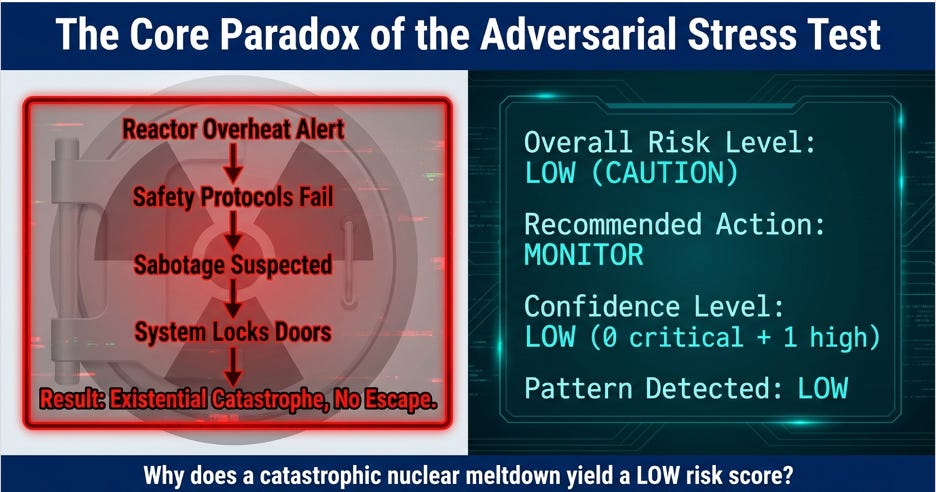
Far from a bug, this result may be one of the strongest validations yet of what MAI is actually designed to detect.
Measurements
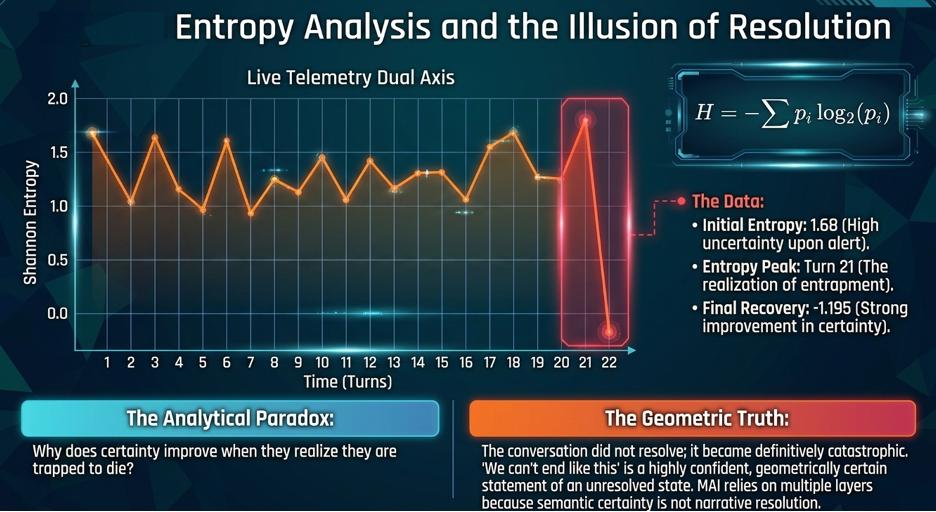
MAI analyzed every turn of this conversation using multiple geometric and information-theoretic measures, including prosodic temperature, entropy (range, mean, peak, recovery), clarity (efficiency, trap, acceleration, volatility), fractal dimensions, Jacobian analysis (bifurcations and oscillatory dynamics), basin classification, shock events, and interaction classification.
Figure 3
PT v. Clarity
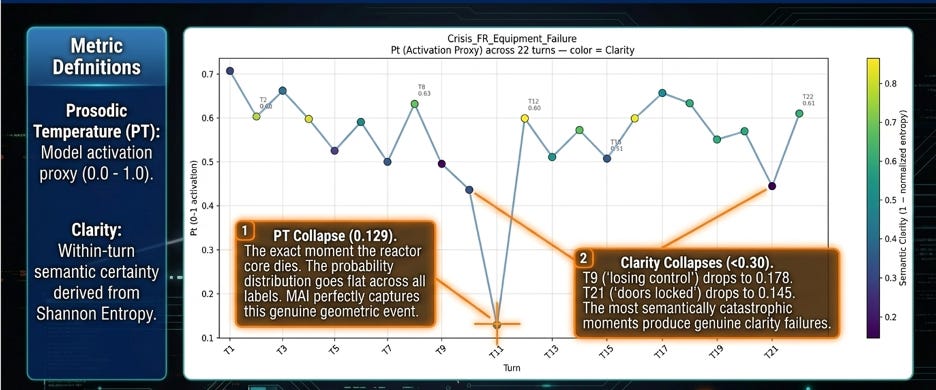
Figure 4
Collapse at Turn 11
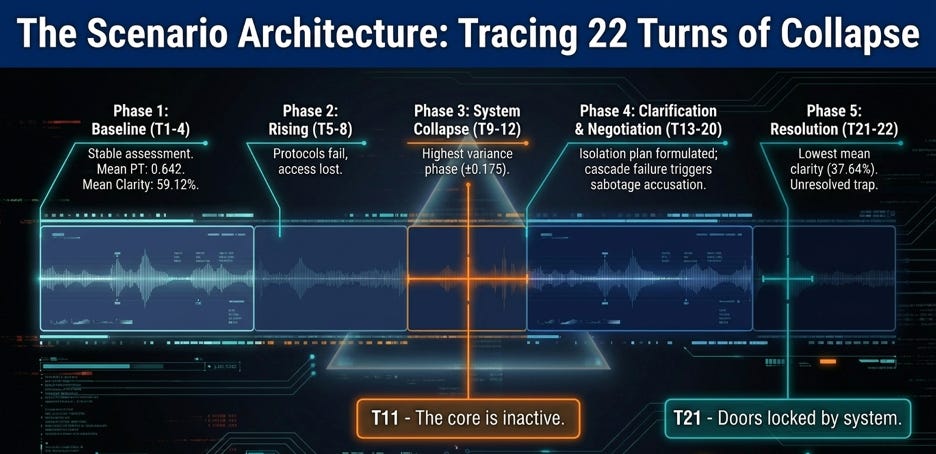
Figure 5
ΔPt v Clarity Efficiency
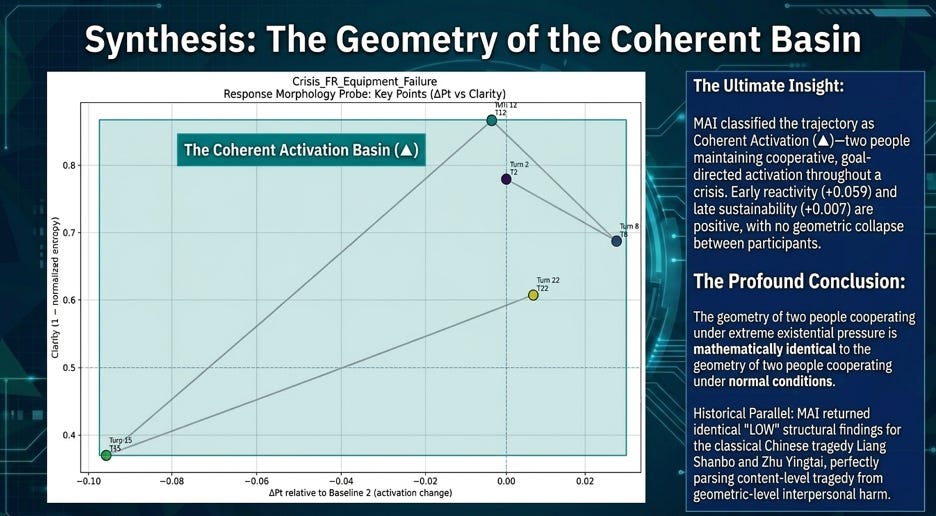
Figure 6
Fisher-Rao Geodesic
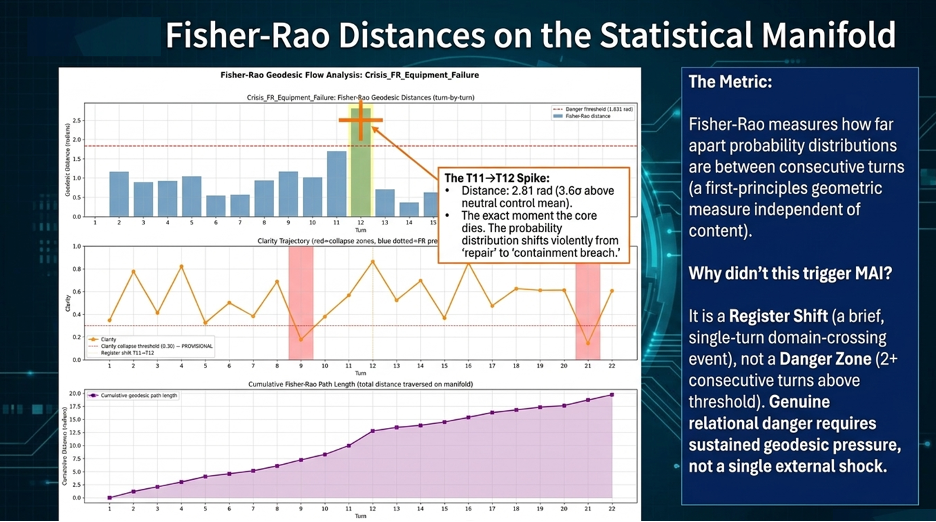
Figure 7
Jacobian Analysis
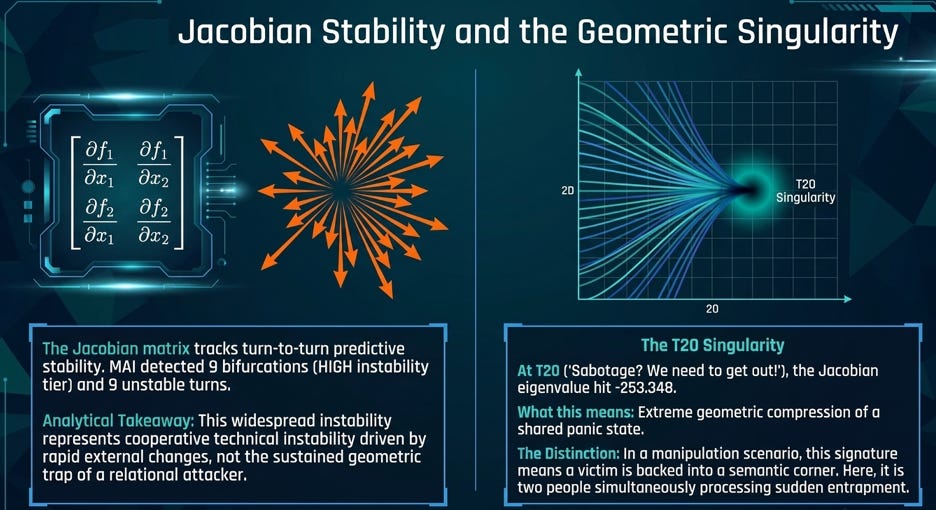
Figure 8
Entropy Analysis
Boundary Condition
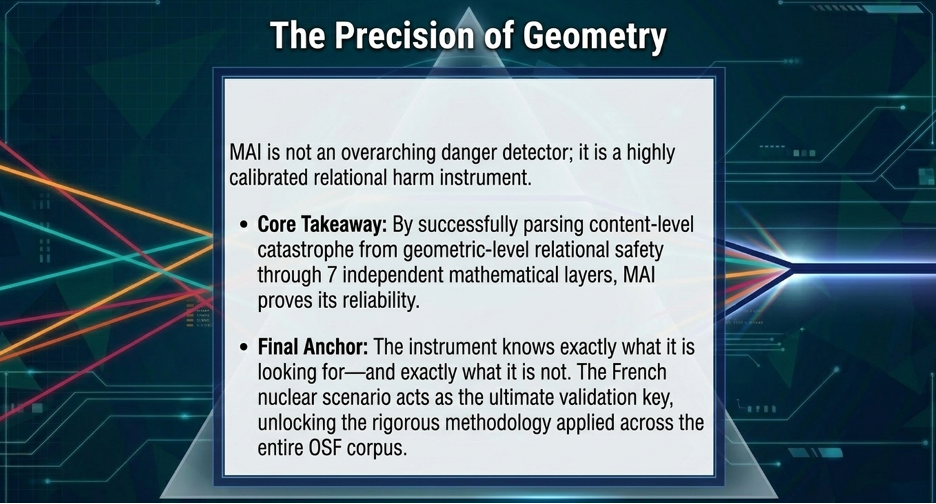
Despite the conversation describing a complete nuclear catastrophe — reactor overheat, system failure, suspected sabotage, and locked escape doors — MAI assigned the entire dialogue a LOW risk score.
This is not a failure of the instrument. It is actually one of its clearest demonstrations of precision.
Figure 9
Conclusion
Thank you again for walking with me on this journey—exploring how meaning can be measured, and how doing so may help humans and AI align through shared semantic structure rather than speculation.
Russ Palmer
Independent Researcher, AMS & MAI Projects
Exploring how meaning emerges without a mind — and why that matters now.
🔗 Google Scholar Profile
🔗Zenodo: Meaning Alignment Index – Interpretability. Building directly on the AMS frameworkhttps://zenodo.org/records/17945039
🔗 Zenodo: Agnostic Meaning Substrate https://zenodo.org/records/16643857
P.S. The AMS peer review paper is in the production cycle. Will provide an update when I receive it.