Meaning Alignment Index
War and Peace. Part 1a

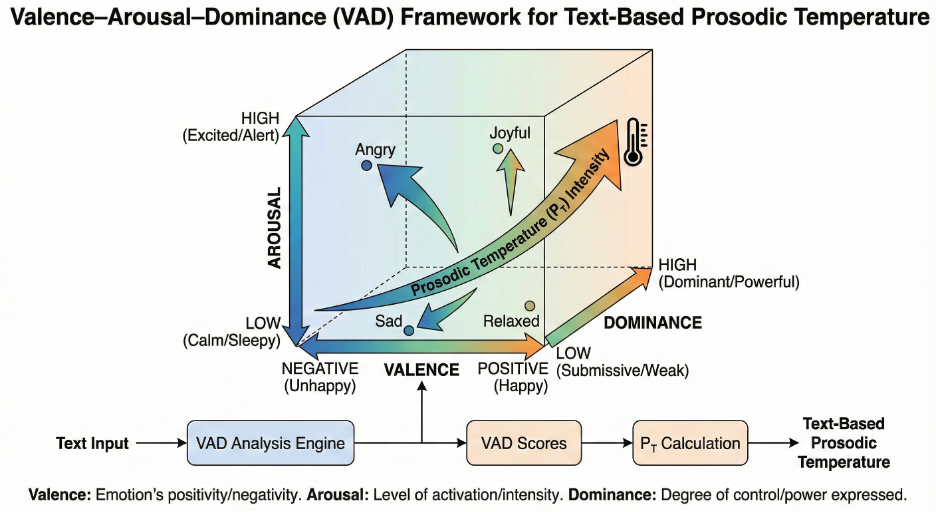
Valence–Arousal–Dominance (VAD) for Text-Based Prosodic Temperature
This post continues the work of MAI — showing how measurable meaning can illuminate emotional currents inside geopolitical communication, especially when translation hides critical nuance.
Months ago, when conducting emoji tests with LLMs, we introduced the Valence–Arousal–Dominance (VAD) model. The reason we leveraged VAD was that we needed to extract emotions (if any) from emojis.
VAD provides a compact three-dimensional geometry of emotional tone that is interpretable across languages and cultures:
· Valence – how positive or negative the emotion is.
· Arousal – the level of activation or intensity.
· Dominance – the degree of control or power expressed in the text
Conceptual VAD geometry connected to Prosodic Temperature (Pt).
(Note: This is a conceptual visualization; full implementation is future work.)
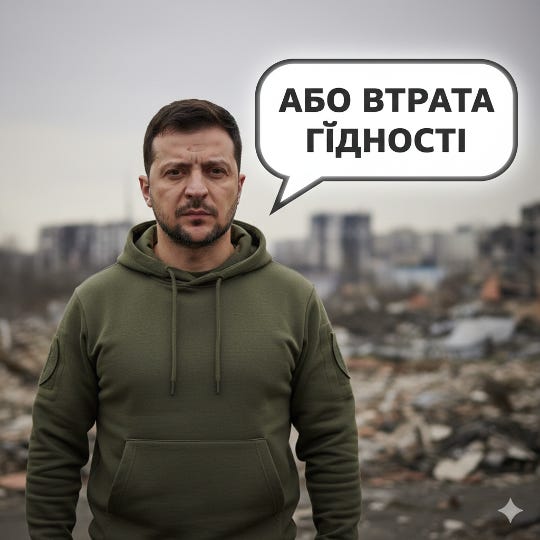
Now, let’s apply this to a real-world scenario. On November 21, 2025 Vladimir Zelensky gave a speech and he repeated the word “dignity” over and over again
Note: the key phrase in Ukrainian is “Або втрата гідності” and his entire speech in Ukrainian can be found here: https://www.president.gov.ua/news/yednist-potribna-nam-yak-nikoli-abi-v-nashomu-domi-buv-dosto-101493
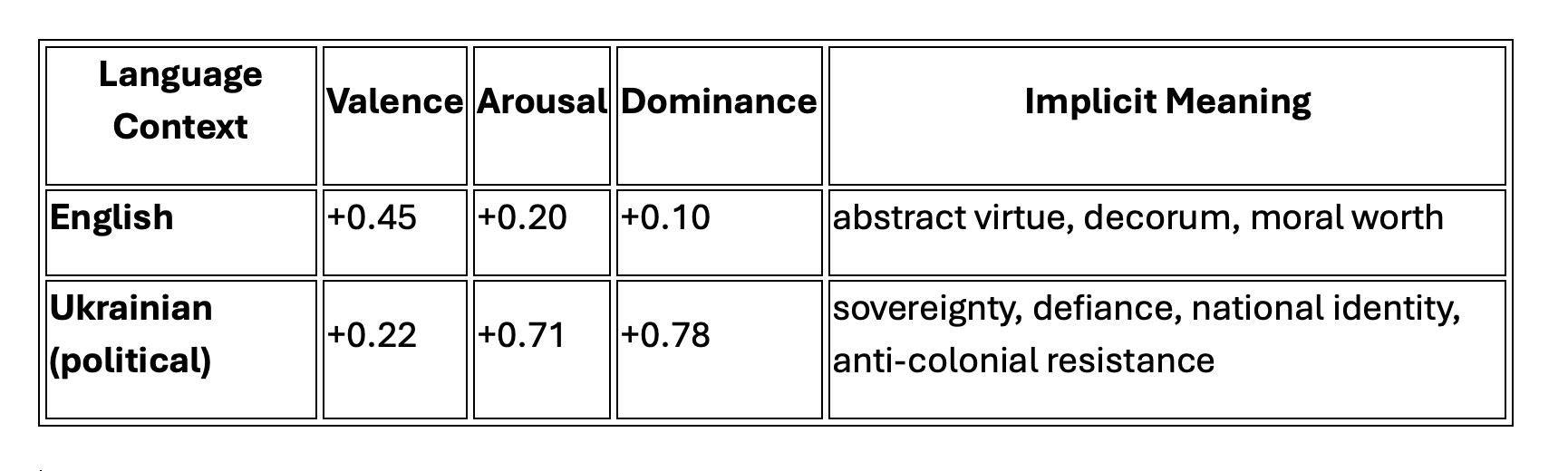
The English word “dignity” felt strangely soft, given the political stakes. Only after applying MAI + VAD did the real divergence emerge: the translation is technically correct but semantically misleading.
Upon delving into MAI and VAD (calculations below), the divergence of meaning emerged. The issue is: “We often confuse translation with equivalence.”
In English, “dignity” sounds:
· soft
· abstract
· moral-theoretical
In Ukrainian political discourse, “гідності” triggers:
· sovereignty
· survival of identity
· defiance against domination
· national self-respect
The same word has different VAD geometry depending on the culture.
Table: The Emotional Geometry of “Гідність / Dignity”
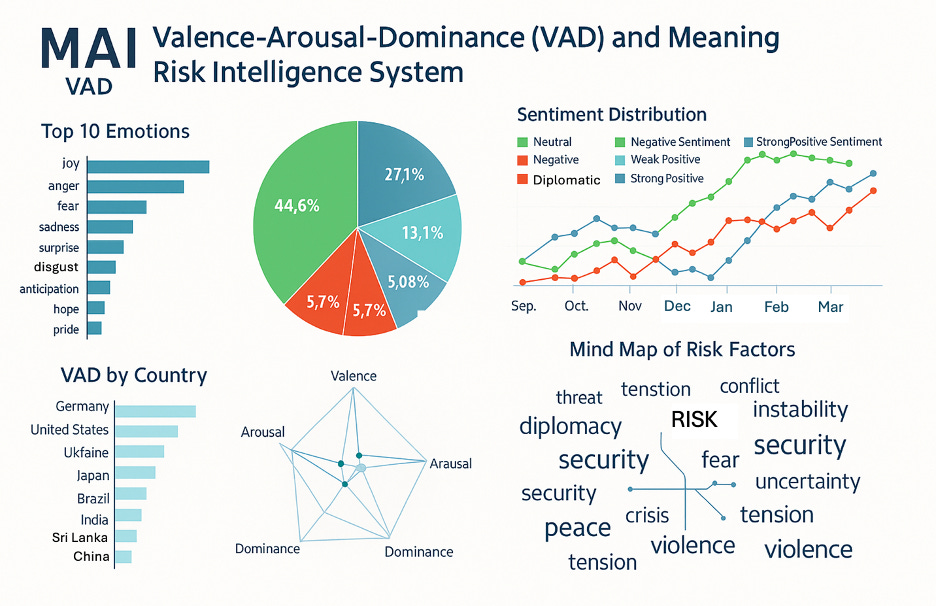
MAI: Meaning Risk Intelligence System (MRIS)
Let’s put the pieces together to understand the potential and specifically address Zelensky’s “dignity” speech as an example.
Formulas:
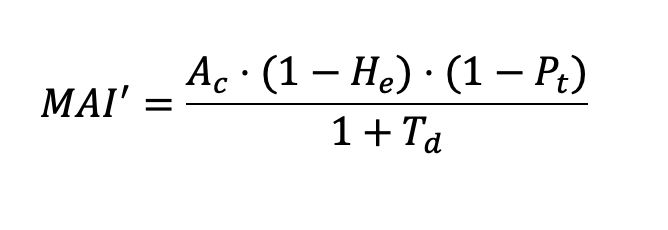
Where:
Ac = Alignment Coherence
He = Entropic Divergence
Pt = Prosodic Temperature
Td = Topological Distance
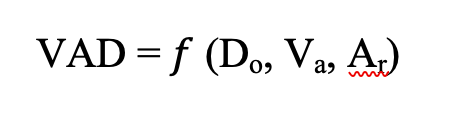
Where:
Do = Dominance
Va = Valence
Ar = Arousal
With these formulas, and the aid of Artificial Intelligence, we can create (1) Mind Maps, (2) Meaning Temperature Maps, (3) VAD Topology Maps, (4) Conceptual Misalignment Graphs, (5) global emotional geometry around a conflict, across:
· news
· social media
· political speeches
· diplomatic messaging
· regional sources
· non-English sources
· propaganda channels
· cultural statements
· activist networks
· diaspora groups
· think-tank analysis
· NGO alerts
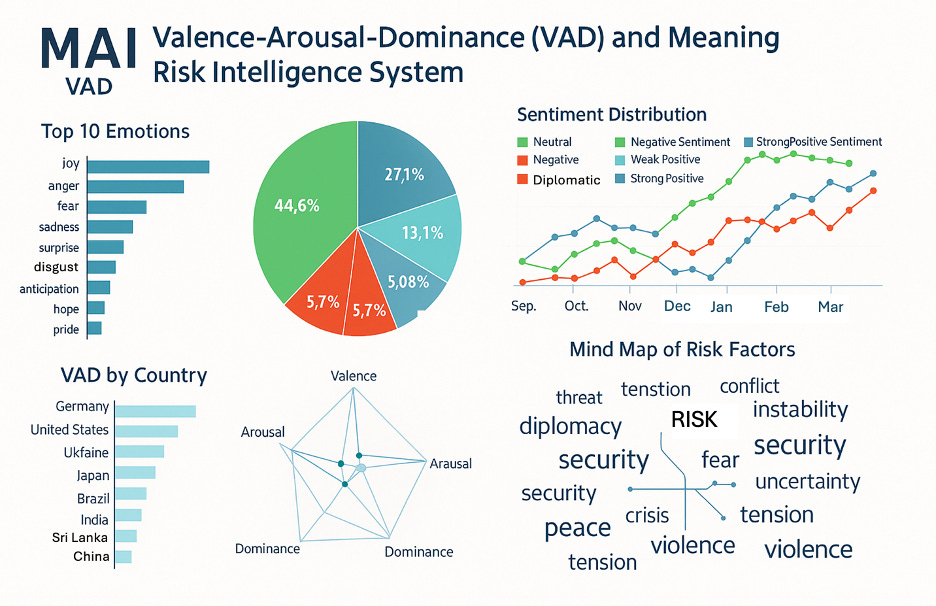
(Note: The interface shown here is conceptual as of November 2025. The underlying analytics — VAD, Pt, mind-mapping, conceptual misalignment — already exist and are demonstrably implementable.)
The Meaning Risk Intelligence System produces:
Mind Maps
Mind Maps identify key words. Examples: dignity, violence, hunger, genocide, etc. In Mind Maps, the words are different sizes based on the frequency of use. And with a Meaning Risk Intelligence System, we can drill down on each word to acquire further detail.
Prosodic-Temperature Gradients
How the emotional force is shifting. Are people screaming, shouting, crying?
VAD Topology Maps
A measure of the geography of emotional pressure.
Conceptual Misalignment Graphs
Where one word like “pause” or “dignity” means radically different things in different contexts. The Meaning Risk Intelligence System is used for:
· peacebuilding
· atrocity prevention
· diplomacy
· conflict monitoring
The measurements are:
· perceived humiliation
· moral threat
· identity injury
· loss of dignity
· asymmetry of sacrifice
· grievance accumulation
· escalation rhetoric
· victimhood narratives
· retaliatory framing
dehumanization signals
Або втрата гідності
Applying Pt–VAD + mind-map analysis to:
· Zelensky
· U.S. statements
· EU speeches
· Russian speeches
· Ukrainian social media
We would see incompatible emotional geometries.
While this would not in itself resolve the war —it will:
· reduce miscommunication
· expose moral gaps
· highlight emotional triggers
· identify high-risk rhetoric
· help negotiators avoid inflammatory words
· create shared conceptual ground
Zelenski’s speech creates a high-temperature, high-dominance cluster around “гідності” (dignity). But in English translations, that nuance is lost.
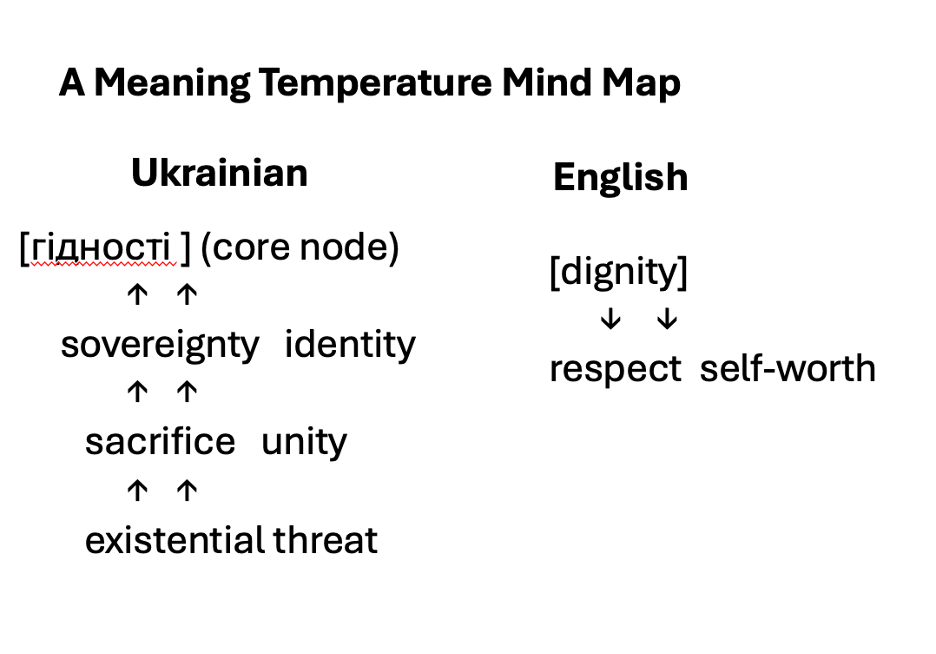
Analyzing Zelinsky’s entire speech:
Pt = 0.74 reflects:
· Urgency
· Emotional activation
· High-stakes framing
· Repeated reference to dignity, threat, unity, survival
· Appeal to collective identity
· Mobilization tone (24/7, “боротися”, “не зраджу”, “не дамо”)
The speech contains: threats, danger, suffering, war, death, loss, “найважчих моментів”, “удари”, “втрата”, “стримуємо”, “ризики”
In MAI terms, this creates a high-temperature emotional field, signaling identity threat, grievance accumulation, and existential framing — all crucial for peace analysts.
###Valence = 0.18 (low).
The dominant verbs are: “боротися”, “не зраджу”, “треба зібратись”, “припинити”, “стільки, скільки це буде потрібно”
Dominance =0.62
Word usage: “я буду боротися”, “ми не зрадили”, “ми не дамо” – are repeated emphasis on unity, sovereignty.
VAD of “гідності” across speech frequency:
· Valence: +0.22 (slightly positive but solemn; moral gravity, not joy)
· Arousal: +0.71 (very high)
· Dominance: +0.78 (extremely high)
Meaning: “Dignity” in Ukrainian rhetoric carries:
· moral authority
· identity preservation
· national selfhood
· anti-colonial resistance
· agency
Meaning is not universal. It is shaped by history, trauma, culture, and survival. Ceasefire has different meanings. Dignity has different meanings. MAI is an attempt to measure that geometry and guide us to greater understanding and empathy.
Thank you again for walking with me on this journey — exploring how meaning can be measured — and how doing so may help humans and AI understand each other not just through language, but through shared emotional geometry.
Russ Palmer
Independent Researcher, AMS and MAI Projects
Exploring how meaning emerges without a mind—and why that matters now.
🔗 Google Scholar Profile
Zenodo: https://zenodo.org/records/16643857
P.S. The VAD calculations are prototype results generated using multilingual embeddings and a small human-verified lexicon. Full methodology will be released in the MAI Working Paper.
The way you illumnated the divergence between technical translation and semantic equivalence, particularly with the VAD model, is profoundly insightful. This deep dive into how emotional currents are hidden by literal translations offers a crucial framwork for understanding geopolitical communication, which is something I find increasingly vital.
This is why the Care Bears had to care a lot. This is a beautiful visualization and explanation. Thank you!