Calling Music Lovers
The Meaning of Music


A child can blow a soap bubble. The bubble’s color depends only on film thickness and light angle — not on what gas is inside. In the same way, the meaning of music lives in the geometry of its semantic trajectory, not in the language of its lyrics.
I am building a system that renders that geometry as colors and motion. The goals are twofold: (1) to help deaf and hard-of-hearing audiences see the meaning of music — not the lyrics, not the waveform, but the emotional geometry; and (2) to help anyone who wants to see the hidden structure of music that they can currently only sense and feel.
The goal is to train models to understand musical intent and expand access to the hidden structure of art.
Models today cannot read sheet music. They do not know that a D7 chord wants to resolve, or that a sudden shift to a minor key can feel like a sigh. They cannot yet distinguish between a true resolution and a cliffhanger. Meaning in music is not the notes or the beat — it is what happens between them.
While models can statistically pattern-match, that is not the same as understanding musical meaning. At one point, models could not reliably distinguish a dog from a bird in images. They can today because humans taught them through structured training data. We have the same opportunity now with music.
What is needed
People willing to contribute in one or more of these ways
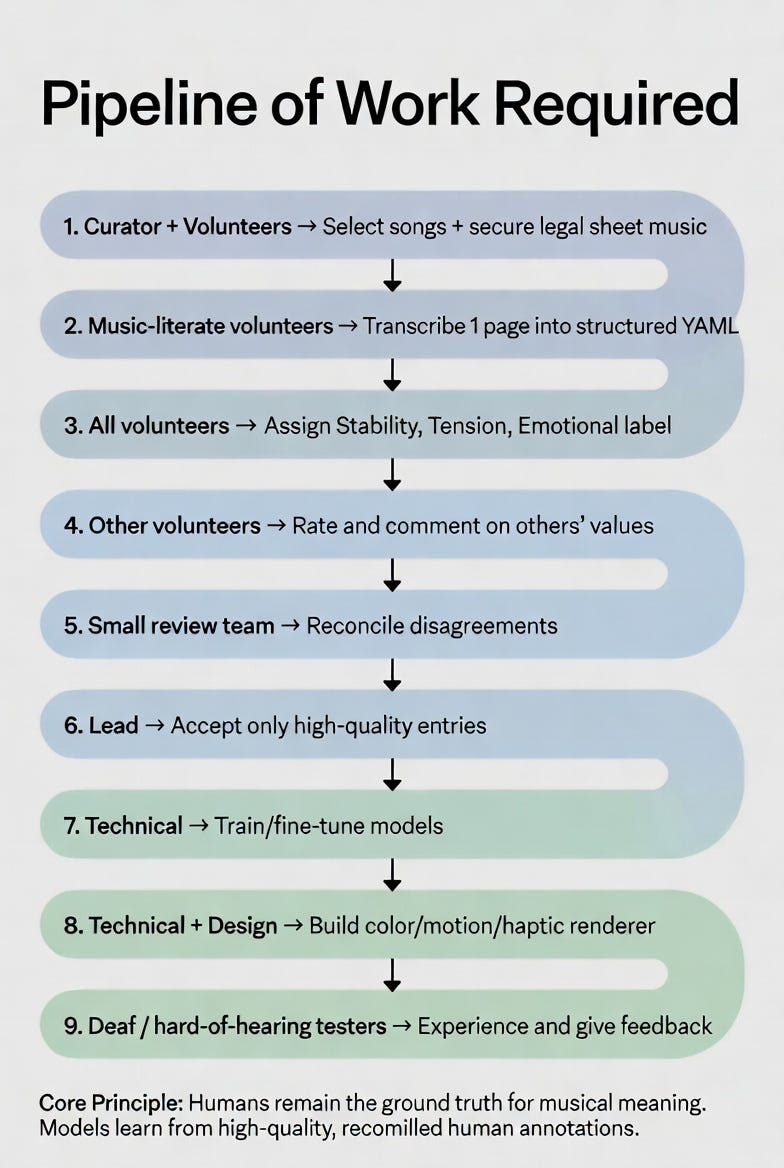
Annotate — Listen to one page of sheet music and assign three simple provisional values to each measure:
Stability (0.0 – 1.0)
Tension (low / moderate / very high)
Emotional trajectory (a short phrase describing how that measure feels)
Transcribe — Convert one page of sheet music into a structured, machine-readable format (YAML). An example is already available for reference. Models cannot read traditional notation; they need this structured representation of notes, chords, and movement.
Review — Examine other people’s provisional values and either agree or suggest an alternative, with a short note explaining your reasoning. A reconciliation process (discussion and consensus) will handle differences of interpretation.
In short, this work needs careful ears and honest judgment. You do not need to be a professional musician — only someone who can listen thoughtfully while following the score.
How to help
If you love music and would like to contribute, reply to this post, send a DM, or leave a comment. You can participate in different ways:
📝 Annotate — Assign stability and tension values (no music theory required)
🎼 Transcribe — Convert sheet music into structured YAML (music literacy helpful)
👁️ Review — Evaluate others’ annotations (ears + honesty)
🔁 Share — Forward this post to one person who loves music. Post on your Facebook.
Even contributing to a single page of one song is valuable.
The framework is ready. The visual and motion mappings are prepared. The only missing element is thoughtful human judgment grounded in listening.
Thank you.
I am working with Ellen Davis — daughter of Channa Horwitz, whose Sonakinatography bridged sound, motion, and notation — to ensure this project honors the visual geometry Channa pioneered.
I am an independent researcher working at the intersection of meaning geometry, AI alignment, and accessibility. My work is peer-reviewed, open-access, and non-commercial.
Thank you again for walking with me on this journey — exploring how meaning can be measured, and how doing so may help humans and AI align through shared semantic structure rather than speculation.
Russ Palmer
Independent Researcher, AMS & MAI Projects
Exploring how meaning emerges without a mind — and why that matters now.
🔗 Google Scholar Profile
🔗 Peer Review Citation: Palmer, R. (2026). The Agnostic Meaning Substrate: A Theoretical Framework for Emergent Meaning in Large Language Models. Artificial Intelligence and Applications. https://doi.org/10.47852/bonviewAIA62027318
🔗 Zenodo Preprint Theoretical Paper: Agnostic Meaning Substrate https://zenodo.org/records/16643857
🔗 Zenodo Preprint Theoretical Paper: Meaning Alignment Index – Interpretability. Building directly on the AMS framework https://zenodo.org/records/17945039
P.S. I continue to work on the Meaning Alignment Index – Interpretability peer review manuscript, and this will take time to complete.
I just restacked this with a note here and at Facebook. Here is what I said:
This is from Russ Palmer, a friend of mine, a scientist who posts [here] on Substack and has just published a peer review paper on the AMS - Agnostic Meaning Substrate. This project below is an outgrowth of his discovery and research of MAI - Meaning Alignment Index.
The implications of this work go beyond the amazing possibility of giving people who are hearing impaired a sense of the deep feeling of music. This can also be used for diplomacy, mediation and meeting in understanding beyond cultural differences and world views.
He sees my mother, Channa Horwitz in her work with Sonakinatograhy as a pioneer to this - and in a way, I see his work as a sophisticated expression and outgrowth of its concept (although not technically an expression of her compositions). This work also relates to synesthesia - hearing color, seeing music, feeling sound, etc.
If you are a musician or composer and are interested in being part of this potentially positive and transformational work for humanity, please let me know, or better yet, reply to his post (linked here) on Substack.